The “Low Risk Product Ladder”: Testing Categories Without Going Broke
One of the sneakiest POD mistakes is testing too expensively.
Not “expensively” in the sense of buying pallets of inventory (thank goodness POD saves us from that), but expensively in the sneaky way that drains creators just as fast:
You pick a product category that sounds exciting, invest energy building a whole line, and then discover:
- the audience didn’t actually want that format
- the price point doesn’t work
- the mockups didn’t sell it
- the category doesn’t fit the niche
And suddenly you’re sitting there with a folder full of designs you don’t feel like touching again, because your brain associates them with wasted effort.
The solution isn’t “never experiment.”

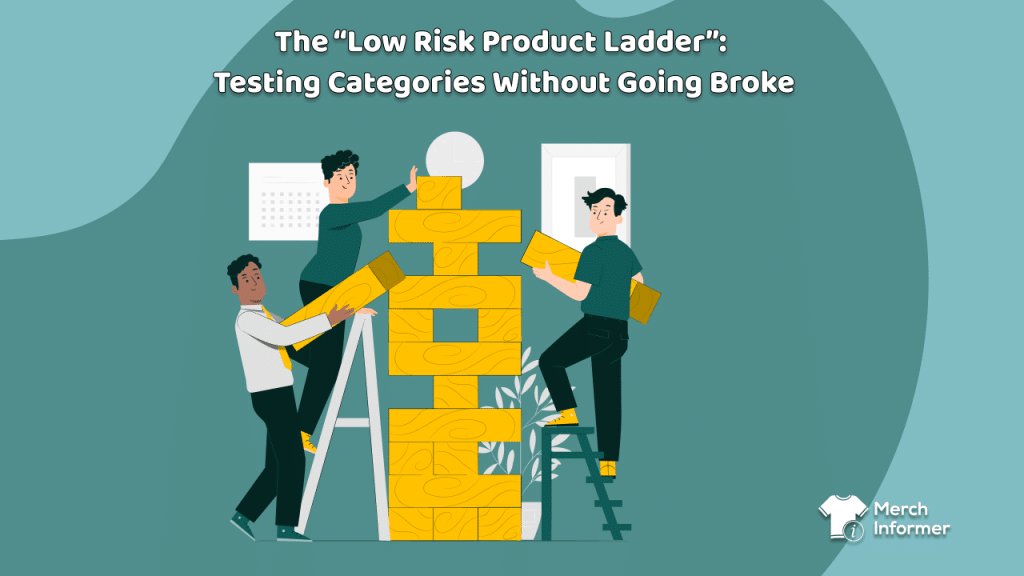
It’s to experiment with a low risk product ladder — a sequence of products that lets you test demand without committing to high complexity right away.
This is how you stay creative and sane.
Why POD makes people over-test (and why that’s a trap)
POD is seductive because it’s so easy to start.
You can upload a design, pick a product, and list it in minutes. That speed creates a dangerous illusion: “If it doesn’t work, I’ll just try something else.”
In theory, yes. In real life, “trying something else” costs:
- time
- attention
- emotional energy
- and that fragile creator confidence that fuels consistency
What burns people out in POD isn’t one failure. It’s death by a thousand “tests” that never turn into something stable.
The low-risk product ladder prevents that by making testing more strategic. You’re not “randomly trying stuff.” You’re building evidence.
A quick story: why “category excitement” is not a strategy
Imagine two sellers:
Seller A falls in love with a product category because it’s cool. They build a whole mini line. They spend hours perfecting mockups and copy. They launch.
Nothing happens.
They assume the design is bad… but maybe the real issue is that the category doesn’t match how their niche buys.
Seller B starts with a low-friction product category, gets a few sales, watches which designs resonate, and then expands with proof.
Seller B looks slower at first, but they become consistent. Seller A gets emotionally whiplashed.
POD rewards Seller B.
The principle: test with the easiest products first
Your first rung should be products that are “low friction,” meaning:
- no sizing issues
- simple printing areas
- easy buyer understanding
- strong gifting behavior
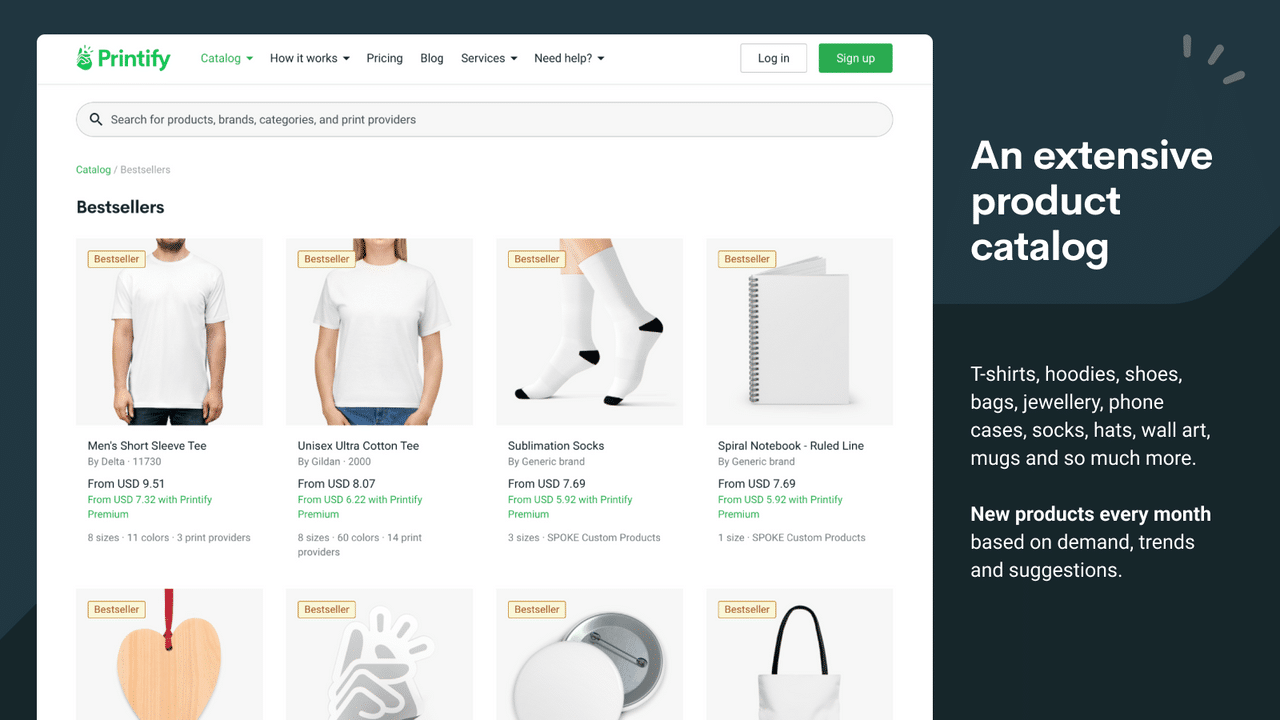
Think in categories like:
- stickers
- mugs
- totes
- simple tees
(Depending on where you sell, you’ll adjust — but the principle stays the same.)
Low-friction products are forgiving. They’re easier for buyers to say yes to, and easier for you to troubleshoot if something isn’t converting.
That’s why they’re the first step in the ladder.
Step 1: Start with “low friction” products
The goal of rung one is not “make a fortune.” It’s validation.
You want to answer:
- Does this niche respond to this design voice?
- Do people understand the joke / sentiment?
- Is the aesthetic landing?
- Will buyers pay for this vibe?
Low-friction categories make those answers easier to get quickly because the buyer decision is simpler.
Why low-friction converts faster: because the buyer can “get it” immediately:
- A sticker is a small identity statement.
- A mug is a giftable ritual object.
- A tote is a no-sizing lifestyle billboard.
- A simple tee is a familiar format.
If a niche likes your concept, these products will usually show it first.
Step 2: Let buyers prove what they want
Testing isn’t “what do I like?”
Testing is “what does my audience buy?”
This is where a lot of creators accidentally sabotage themselves. They get attached to their own preferences and ignore buyer behavior.
The low-risk ladder keeps you honest. Once you get traction, you’ve earned the right to expand. And notice what that does psychologically:
- You’re no longer guessing.
- You’re building on evidence.
- Your confidence grows because the market is giving you signals.
A practical way to “listen” to buyers
Look for:
- repeat purchases (even small ones)
- favorites / saves
- which phrases/designs get clicked more
- which designs get bought without discounting
Those are your winners. Winners earn expansion.
Step 3: Expand to “gift upgrades”
Next rung: products that are still easy, but higher perceived value:
- hoodies/sweatshirts
- tumblers
- nicer decor items
- multi-item sets (collection style)
Think of gift upgrades as the “yes, I’ll spend more” category.
If rung one proves the niche likes your vibe, rung three captures higher value by offering:
- more warmth (hoodies)
- more “daily ritual” value (tumblers)
- more home identity (decor)
This rung is also where AOV starts rising naturally because buyers begin treating your shop like a brand, not a one-off purchase.
Step 4: Add premium only when the niche is validated
Premium categories can be amazing — but they’re best when you already know the niche converts. Premium items often have:
- higher price sensitivity
- higher expectation sensitivity
- more complicated mockup needs
- higher chance of “this isn’t what I imagined”
So you don’t start there unless you enjoy pain. You go there once your catalog already has proof of life. When you’ve validated:
- your niche
- your aesthetic
- your voice
- your best-selling phrases
…then premium products become a smart expansion, not a gamble.

The “ladder logic” (how this prevents burnout)
The low risk ladder works because it prevents three common POD burnout spirals:
Spiral #1: The “I made a whole line and nobody bought it” crash
You stop doing that. You validate first.
Spiral #2: The “I keep switching products and I don’t know what’s working” fog
You build in stages, so signals are clearer.
Spiral #3: The “I can’t scale because everything is chaos” trap
The ladder forces you to systematize:
- your niche
- your design style
- your product ladder
- your collections
It’s not just safer. It’s cleaner.
A simple example ladder you can copy (generic but useful)
Let’s say your niche is “teachers” and your vibe is “funny coffee.”
Rung 1 (validation):
- sticker
- mug
- tote
If those sell, you now have proof that:
- teachers like the joke
- they like the aesthetic
- the niche is alive
Rung 2 (gift upgrade):
- sweatshirt/hoodie
- tumbler
- a matching set concept (mug + tote + sticker family)
Rung 3 (premium):
- larger gift items (blanket, wall art set, etc.) only if you see consistent conversion
Notice: you didn’t guess your way into premium. You earned it.
A healthy testing rule: “test one thing at a time”
Here’s the simplest way to keep testing from becoming chaos:
When you test, change only one variable.
- Same niche, new product category
OR - Same product category, new niche
OR - Same niche/product, new design voice
If you change everything at once, you can’t tell what worked.
The ladder naturally enforces this discipline.
Final thought
The low risk product ladder doesn’t make you less ambitious. It makes you more sustainable.
It lets real customers tell you where to grow.
And that’s the point: POD is powerful because it allows experimentation. But the creators who win aren’t the ones who experiment endlessly.
They’re the ones who experiment strategically, then build a catalog that grows with confidence instead of chaos.