One Design, Many Stores: How a Single Upload Workflow Changes the Game
POD doesn’t get hard because design is hard. POD gets hard because repetition is hard.
The part that burns people out isn’t making one good design — it’s doing the same “admin loop” over and over:
- upload again
- rewrite the same listing again
- re-enter keywords again
- re-check variants again
- track where you posted again
That’s where creators quietly stall out.
And it’s sneaky, because from the outside it looks like you’re “doing the work.” You’re busy. You’re posting. You’re tweaking. You’re optimizing. But inside, the energy drain feels like this:
“Why does this take so much effort for so little output?”

That question is the beginning of burnout.
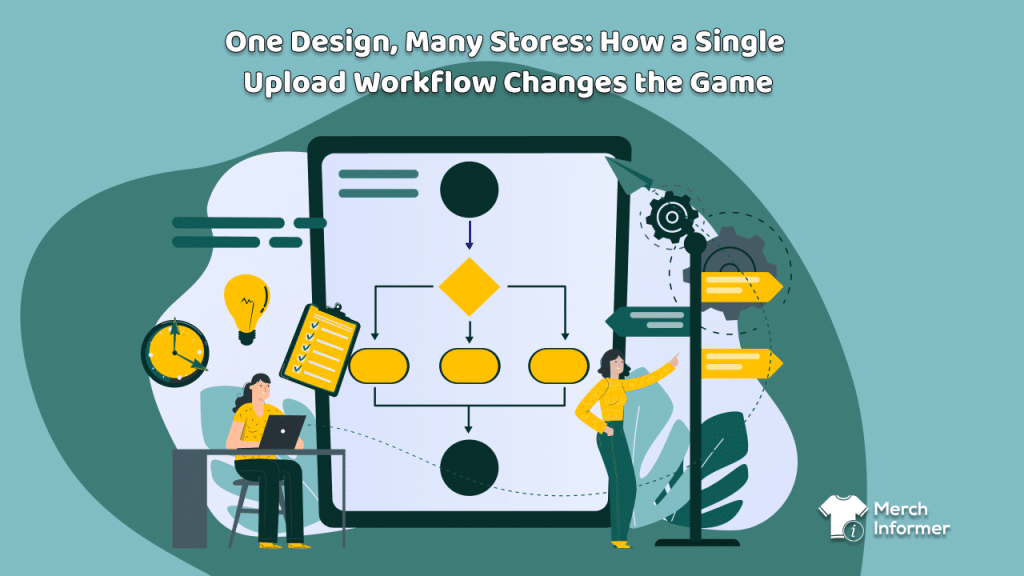
A single-upload mindset changes everything because it shifts POD from “random posts” to catalog building. When you can distribute a design across multiple channels without redoing the entire process from scratch each time, you start thinking bigger — not in a frantic way, but in an organized way.
And this matters whether you’re a full-time seller, a side-hustler, or someone squeezing POD into the corners of a real life. Because the more limited your time is, the more punishing duplicate admin becomes.
A quick story: the “design is done, but I’m not done” problem
Most creators know this moment.
You finish the design. You’re proud. The hardest part — the creative part — is done. And then you realize you’re not done at all. Now you have to:
- upload it
- format it
- write a title
- write a description
- pick tags
- double-check placement
- choose variants
- make mockups
- repeat it for the next platform
- repeat it again for the next product
That’s the “design is done, but I’m not done” problem.
It’s not that any single step is terrifying. It’s that the steps multiply. And once they multiply, they become emotionally heavy.
That’s why creators stall. Not because they lack creativity, but because they’re drowning in repetition.
A single-upload workflow isn’t just an efficiency upgrade. It’s a mental health upgrade.

A single-upload mindset doesn’t mean “be everywhere”
Let’s get this out of the way:
This isn’t a pitch for “you must sell on ten platforms.” You don’t have to be everywhere. A single-upload mindset is about readiness, not chaos.
It means:
- your files are organized
- your listing language is consistent
- your naming system is repeatable
- your catalog structure is coherent
- your workflow doesn’t collapse if you expand later
In other words: it’s about creating a system that doesn’t trap you inside one platform or one product type.
You can start in one place. But you build in a way that gives you freedom later.
The real benefit isn’t speed — it’s consistency
Single-upload workflows get talked about like “time savers,” but the deeper advantage is consistency.
A single-upload workflow helps you stay consistent in:
- naming
- branding
- keywords
- tone of voice
- product selection
- collection structure
And on marketplaces, consistency reads as quality.
Buyers don’t always know how to describe it, but they can feel it:
- “This shop is professional.”
- “This seller has their act together.”
- “Everything matches.”
- “I trust this brand.”
Consistency is what makes your shop feel trustworthy. Trust is what creates repeat buyers. Repeat buyers is what makes this feel like a business instead of a hustle.
The “catalog effect”: why consistency creates more sales
Here’s what happens when you build a cohesive catalog instead of random listings:
A buyer clicks one item… and then keeps browsing because the shop makes sense.
They see:
- matching styles
- related products
- consistent voice
- a clear niche
- “Oh, there’s more like this.”
And now you’ve increased the two most valuable things on a marketplace:
- session time (they stay longer)
- multi-item intent (they want more than one thing)
This is how AOV increases without “bundles.”
This is how followers happen.
This is how repeat purchases happen.
Random shops get single sales. Catalog shops build audiences.

The mental shift: from “listing” to “library”
Instead of asking:
- “What should I upload today?”
You start asking:
- “What belongs in my catalog?”
- “What’s the next product rung for this niche?”
- “What variations are worth adding?”
That is the difference between “I sell some POD things” and “I have a brand.”
A library mindset is calmer because it reduces daily decision fatigue.
You’re not reinventing your shop every time you sit down to work. You’re adding the next logical book to a shelf that already has a theme.
And that’s why creators with catalogs last longer. They’re building a system, not sprinting forever.
What “one design → many stores” looks like in real life
Let’s make it tangible.
Imagine you have a niche: teachers.
And a vibe: funny coffee.
You create one strong design idea: “Tiny humans smarter” (or whatever your equivalent is).
A random approach is:
- put it on a shirt
- list it
- done
- move on
- start from scratch tomorrow
A catalog approach is:
- same design family across 3–5 product formats
- consistent listing language
- consistent mockups
- consistent naming (“Teacher Coffee Collection”)
- a few intentional variations
Now you have:
- multiple entry points for buyers
- more “gift fit” options
- more chances to match different preferences
- a shop that looks like it knows what it’s doing
And you did not need to invent a new idea every time.
That’s how you scale without burnout.
Why multi-platform matters even if you start on one platform
You don’t have to be everywhere. But when your workflow is ready for “one design → many stores,” you’re no longer trapped by:
- one marketplace’s rules
- one platform’s traffic fluctuations
- one category’s limitations
You can expand calmly when you’re ready.
This is the “don’t put all your eggs in one basket” benefit — but it’s also a creative benefit.
Some platforms skew:
- gift-heavy
- decor-heavy
- apparel-heavy
- digital-heavy
When you can distribute the same creative DNA across multiple channels, you give your catalog a chance to find its best home.
You’re not dependent on a single algorithm being in a good mood.

The hidden win: fewer mistakes and less “lost work”
A single-upload mindset forces you to build basic organization:
- consistent file names
- consistent folder structure
- consistent product templates
- consistent listing kit language
- a “done list” tracker
Those habits dramatically reduce:
- duplicate uploads
- missing files
- accidentally posting the wrong version
- losing track of where something is live
That kind of friction is what makes creators quit. Not a lack of talent. Just cumulative annoyance. When your workflow is cleaner, you stay in the game longer.
And staying in the game is how you win POD.
How to adopt the mindset without turning into a spreadsheet person
You don’t need a complex system. You just need a repeatable “kit”:
- Design folder (source + final export + listing notes)
- Listing kit (title structure + description structure + tag style)
- Product ladder (your default 3–5 product formats)
- Done tracker (where it’s listed + status + date)
That’s enough to make “one design → many stores” feel manageable. And once that’s in place, distributing your work feels like multiplying—not repeating.
Final thought
A single-upload workflow doesn’t replace creativity. It protects it. It keeps your energy where it belongs: building good ideas into a cohesive catalog — without drowning in duplicate admin.
Because the real goal in POD isn’t to become a machine.