The Art of Pricing: How to Set Competitive Prices on Merch by Amazon

For Merch by Amazon sellers, pricing is a strategic lever: set it too low, and you leave money on the table; too high, and you miss out on sales velocity. With MerchInformer’s suite of pricing and research tools, you can strike the perfect balance between competitiveness and profitability—backed by data at every step.
In this comprehensive guide, you’ll learn:
- Why smart pricing is a business imperative
- Core pricing strategies for different stages of your Merch journey
- Leveraging MerchInformer tools for dynamic, market-based pricing
- Tiered pricing and psychological strategies
- When to use penetration (introductory) pricing
- Ongoing pricing maintenance and refinement
- Case studies from top sellers
- Common pricing mistakes—and how to avoid them
- Full pricing strategy checklist
- Future-proofing your pricing approach
1. Why Smart Pricing Matters
Pricing on Merch affects more than bottom-line revenue—it shapes:
- Ranking and visibility: Amazon weights sales velocity heavily
- Listing impressions: Lower price tags can show more often
- Buyer perception: Premium pricing attracts decision-level buyers, but may deter bargain hunters
- Tier progression: Beginner sellers benefit from quick movement in rankings, unlocking higher tier allotments
Smart pricing isn’t just tactical—it’s strategic.

2. Core Pricing Strategies
MerchInformer identifies three foundational pricing approaches:
a) Low-Ball (Entry) Pricing
Ideal at launch: set price slightly below market average to gain sales velocity. A Reddit user advises:
“Dropping your initial price to gain sales velocity is a sound strategy… employed within the first week or two to gain traction.”
b) Balanced (Market-Based) Pricing
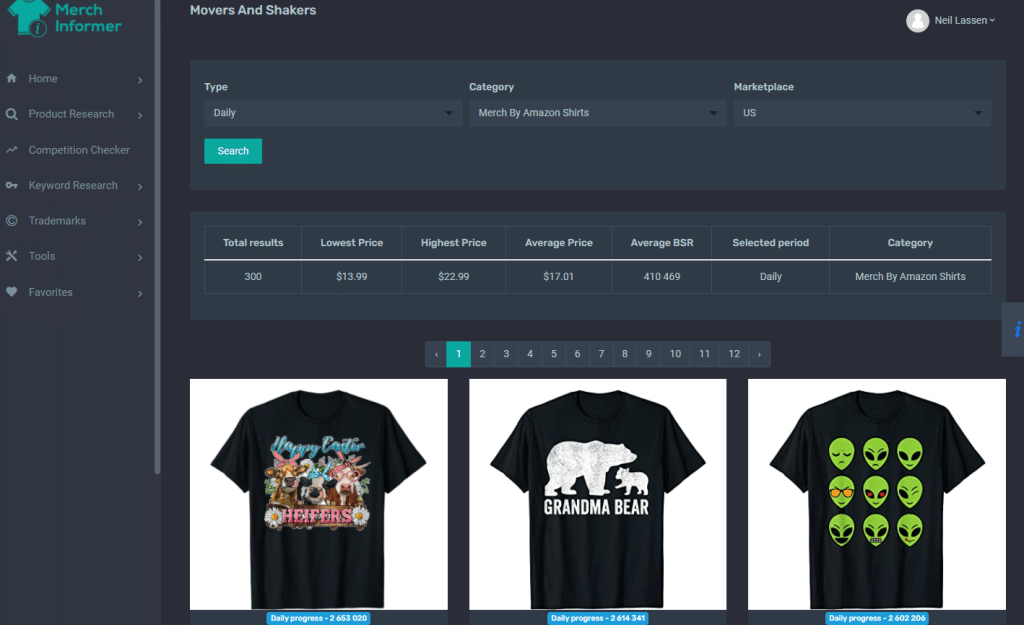
Set your price within ±10–20% of the top listings on page one. MerchInformer suggests going as high as 20% above the highest competitor if you have a strong design and reviews.
c) Premium Pricing
Reserved for best-in-class designs with brand recognition. Position your product between market average and 20% higher—with confidence earned through quality, reviews, and value-add.
3. Using MerchInformer Tools to Inform Pricing
A. Price & Competition Analysis
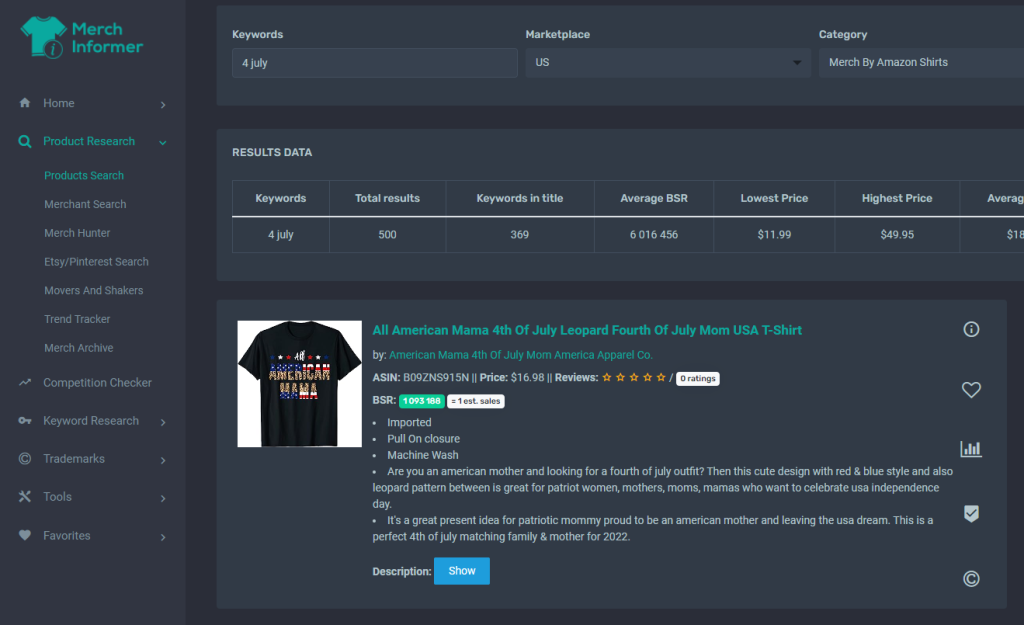
- Use Product Search to view current pricing distribution and average market price
- Check top-earning listings’ minimum and maximum price to map your own pricing tiers
B. Merch Hunter / Trend Hunter
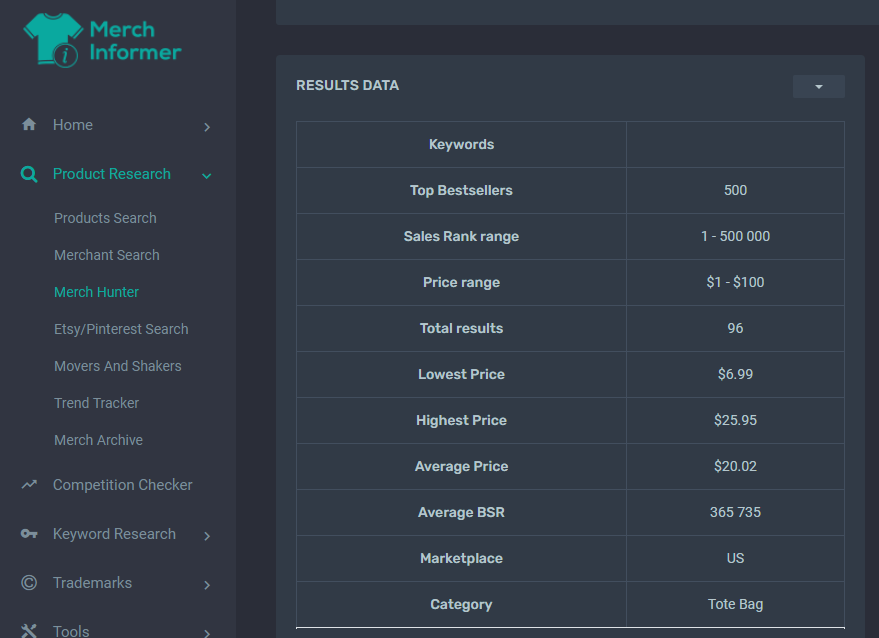
- Validate if the niche is trending upwards—this may justify higher price points
- Conversely, seasonal or slowing trends might need slight markdowns for velocity
C. Product Tracker
- Watch how listing performance responds to price updates
- Use historical tracking to assess price elasticity and demand by SKU
D. Dynamic / A/B Pricing
- Launch one listing at entry price, mirror with competitor-level version
- Compare ASINs after 2–4 weeks to determine elastic response
4. Tiered & Psychological Pricing Techniques
a) Good–Better–Best Structure
- Offer three variants (e.g., basic tee, embellished tee, signature tee) priced incrementally. Psychology dictates buyers tend to choose the middle “Better” option.
b) Just-Below Pricing
- $19.99 feels noticeably cheaper than $20.00—an atomic tweak with outsized effect.
5. When to Use Penetration Pricing
Use low pricing strategy when:
- Launching in new niches
- Entering low-competition or emerging categories
- Testing ad campaigns for ROI potential
Penetration pricing increases visibility quickly—but plan to adjust upward after initial traction.
6. Ongoing Price Maintenance
Make pricing reviews part of your monthly workflow:
- Analyze keyword-level average prices using Product Search
- Identify listings lagging behind competitors
- Test incremental adjustments—up or down based on demand elasticity and sales
- Reassess during high-demand periods (holidays etc.)
- Avoid permanent discounting—only temporary and purposeful
7. Seller Case Studies
Case A: Penetration to Premium
- Launched tee at $17.99 (below $19.99 market average)
- Rank improved, hitting first page quickly
- Increased to $21.99—sales held steady for another 3 months
Case B: Tiered Bestseller Strategy
- Introduced three hoodie variants—price points at $29.99/$34.99/$39.99
- “Better” tier (middle) consistently sold most units (approx. 60%)
8. Common Pitfalls to Avoid
- Leaving price stagnant—market data shifts fast: recheck monthly
- Race to the bottom—constant undercutting damages category health and buyer trust
- Not tracking ad ROI—if your profit margin disappears, ad spend won’t help
- Overpricing early—new listings need visibility, not high margins
9. MerchInformer Pricing Strategy Checklist
| Action Item | Completed? |
|---|---|
| Identify niche’s price range | |
| Launch with entry / low-ball price | |
| Track velocity via Product Tracker | |
| Raise to average price after ranking | |
| Consider premium option if metrics support it | |
| Implement tiered pricing where applicable | |
| Use psychological pricing ($.99 endings) | |
| Review prices monthly | |
| Adjust for seasonal demands | |
| Monitor ROI on any price change |
Future-Proof Pricing Strategy
Pricing isn’t static—it’s a moving conversation between you, data, and marketplace trends. With MerchInformer, you’re not flying blind. You can test, iterate, and scale pricing based on live signals, not gut feel.
Price smart, price thoughtfully—maximized earnings start with informed action.
Bonus: Pricing Workflow Template
To help you apply the strategies discussed above with consistency and clarity, here’s a Pricing Workflow Template designed for Merch by Amazon sellers using MerchInformer. This workflow ensures you’re continuously optimizing your prices with real data, minimizing guesswork, and maximizing return on effort.
You can use this as a monthly ritual, applying it across your entire product line or targeting specific underperforming SKUs.
Merch Pricing Optimization Workflow
Monthly Cycle: 1st to 7th of Each Month
| Step | Task | Tools Needed | Notes |
|---|---|---|---|
| 1 | Select SKUs for review | MerchInformer Product Tracker | Focus on listings with stagnant or declining sales |
| 2 | Pull average price data for niche | MerchInformer Product Search | Record median, top, and bottom 10 prices in your sub-niche |
| 3 | Compare your product’s current price | MerchInformer Listing Analyzer | Is your price too high or too low for visibility? |
| 4 | Analyze competition | Merch Hunter / Trend Hunter | Do top sellers justify higher prices (e.g., reviews, design quality)? |
| 5 | Decide on pricing action | Internal log / spreadsheet | Choose: Raise, Lower, Test A/B, or Maintain |
| 6 | Adjust pricing accordingly | Amazon Seller Central | Be mindful of your royalties vs. price change |
| 7 | Mark changes & date | Internal tracker | Track changes for at least 30 days |
| 8 | Evaluate results | Sales dashboard + MerchInformer Tracker | Did sales velocity increase? Did impressions change? |